Gerry Adams: The Architect of Irish Republicanism and Peace in Northern Ireland

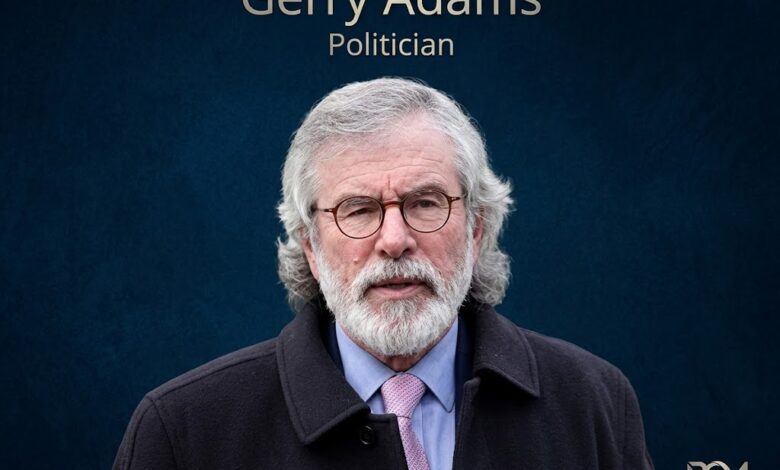
Gerry Adams is a name that carries significant weight in Irish and Northern Irish politics. As a leader of Sinn Féin and a key figure in the peace process that helped end The Troubles in Northern Ireland, Adams’ political journey has been both celebrated and controversial. He is often seen as the embodiment of the shift from militant republicanism to political negotiation in Ireland, with his leadership playing a pivotal role in shaping the course of Irish politics in the late 20th and early 21st centuries.
Early Life and Background
Gerry Adams was born on October 6, 1948, in Belfast, Northern Ireland, to a working-class family. His early life was shaped by the political and social turbulence of post-World War II Ireland. Raised in a Catholic nationalist family, Adams was exposed to the ideas of Irish republicanism from a young age. His father, Gerry Adams Sr., was a committed Irish nationalist and played an active role in the politics of Northern Ireland, which greatly influenced Adams’ own political awakening.
Gerry Adams childhood was spent in the working-class neighbourhoods of West Belfast, an area marked by poverty and political division. In his teenage years, he became involved in the burgeoning civil rights movement in Northern Ireland, which was advocating for equal rights for Catholics, who were often treated as second-class citizens by the Protestant-dominated government. The brutal response to the civil rights movement from the British Army and the police force led to the intensification of the Northern Ireland conflict — what would come to be known as The Troubles.
Joining Sinn Féin and Early Political Engagement
In the late 1960s and early 1970s, as the Northern Ireland conflict escalated, Gerry Adams became increasingly involved in republican politics. He joined Sinn Féin, the political wing of the Provisional Irish Republican Army (IRA), which had split from the mainstream Sinn Féin in the late 1960s due to disagreements over the party’s approach to achieving Irish independence. While Gerry Adams has consistently denied being a member of the IRA, many have claimed that he held significant leadership roles within the organization during the conflict.
Despite this, Gerry Adams focused his efforts on political activism, working to build Sinn Féin’s influence in Northern Ireland and advocating for the unification of Ireland. Over time, Adams rose through the ranks of Sinn Féin, becoming vice president in 1978 and eventually being elected president in 1983, a position he would hold for the next 35 years.
During the 1980s, Sinn Féin adopted a dual strategy of militant resistance through the IRA’s armed struggle and political engagement through elections. This approach became known as the “Armalite and Ballot Box” strategy, reflecting the belief that a combination of military and political means was necessary to achieve Irish independence. This marked a shift in Sinn Féin’s tactics, as the party began to gain electoral support, even as violence continued to escalate in Northern Ireland.
The Peace Process and the Good Friday Agreement
One of Gerry Adams most significant achievements came in the 1990s when he played a key role in the Northern Ireland peace process, which ultimately led to the Good Friday Agreement in 1998. The agreement, also known as the Belfast Agreement, marked the end of The Troubles and set up a power-sharing government in Northern Ireland, bringing together nationalists and unionists to form a new, inclusive political system.
As the president of Sinn Féin, Adams became one of the most prominent republican voices in the negotiations. His participation in talks with both the British government and the Republic of Ireland was pivotal in breaking the deadlock between the nationalist and unionist communities. He played a central role in persuading the IRA to declare a ceasefire in 1994, a crucial step toward peace.
Gerry Adams leadership was instrumental in encouraging Sinn Féin to transition from its association with armed struggle to a purely political movement. While this was a challenging shift for many within the republican community, Adams consistently argued that peaceful negotiation and democratic engagement were the only viable paths forward. His role in negotiating the Good Friday Agreement was crucial in ensuring that Sinn Féin could participate in the newly formed Northern Ireland Assembly and that the party’s political objectives could be achieved without resorting to violence.
The agreement established several important principles, including:
- Power-sharing between unionists and nationalists.
- The devolution of powers to a Northern Ireland Assembly.
- The release of prisoners associated with The Troubles.
- Provisions for cross-border cooperation between Northern Ireland and the Republic of Ireland.
For his efforts in helping to bring about peace, Adams received international recognition, including numerous awards and accolades.
Controversies and Allegations
Gerry Adams has been a highly controversial figure throughout his political career, particularly regarding his association with the IRA and the violent tactics used during The Troubles. Although he has always denied being a member of the IRA, many historians, journalists, and former republican colleagues believe that he played a central role in the organization. The British government, for example, has long suspected that Adams was involved in the IRA’s operations during the conflict.
Gerry Adams role in negotiating peace has often been questioned by critics who argue that his connections to the IRA complicate his contributions to the peace process. Despite these allegations, Adams has consistently maintained that his role in Sinn Féin was strictly political, and he has denied any involvement in paramilitary activity.
In 2014, Gerry Adams was arrested and questioned by police in Northern Ireland regarding the 1972 disappearance and murder of Jean McConville, a mother of ten who was abducted and killed by the IRA. The case remains controversial, and Adams’ involvement was never proven, although his name continued to be associated with the case.
Adams’ Legacy and Influence
Despite the controversies surrounding his past, Gerry Adams remains a highly influential figure in Irish politics. He is credited with reshaping Sinn Féin from a fringe republican organization into a major political party with significant influence in both Northern Ireland and the Republic of Ireland.
Adams’ legacy is also defined by his role in leading Sinn Féin through a period of transformation — from a group associated with violence to a party committed to peaceful political engagement. His political strategy paved the way for Sinn Féin to become a central political player in Ireland, with the party making significant gains in the Republic of Ireland’s general elections in recent years.
Adams’ influence extends beyond Sinn Féin. He has been an important figure in the broader Irish republican movement, a symbol of both struggle and reconciliation. While some view him as a hero of Irish nationalism, others continue to question his past actions and the means by which he achieved political power.
Retirement and Personal Life
In 2018, Gerry Adams announced his retirement from his role as president of Sinn Féin, marking the end of an era for the party. He stepped down after over three decades of leadership, passing the mantle to Mary Lou McDonald, who became the new party leader. Adams’ retirement did not mark an end to his involvement in Irish politics, but it did signal the start of a new chapter for Sinn Féin.
Though he has largely stepped back from the spotlight, Gerry Adams remains an important figure in the conversation about Irish republicanism, Northern Ireland’s peace process, and the future of Sinn Féin. His contributions to Irish politics and the peace process remain central to his legacy, whether as a supporter or detractor.
Conclusion
Gerry Adams is one of the most significant figures in modern Irish history. From his early years as a dedicated republican activist to his leadership in Sinn Féin and the pivotal role he played in the Northern Ireland peace process, Adams’ impact on Irish politics is immeasurable. His journey from paramilitary leader to peace negotiator reflects the evolving nature of Irish republicanism and Northern Irish politics in the 20th and 21st centuries.
His legacy will be defined by his role in bringing an end to The Troubles, as well as the controversial questions surrounding his past. Regardless of the opinions people may hold about his actions, there is no denying that Gerry Adams is a central figure in the history of Ireland’s political transformation.